New York Sweepstakes Casino Crackdown: AG Actions Explained
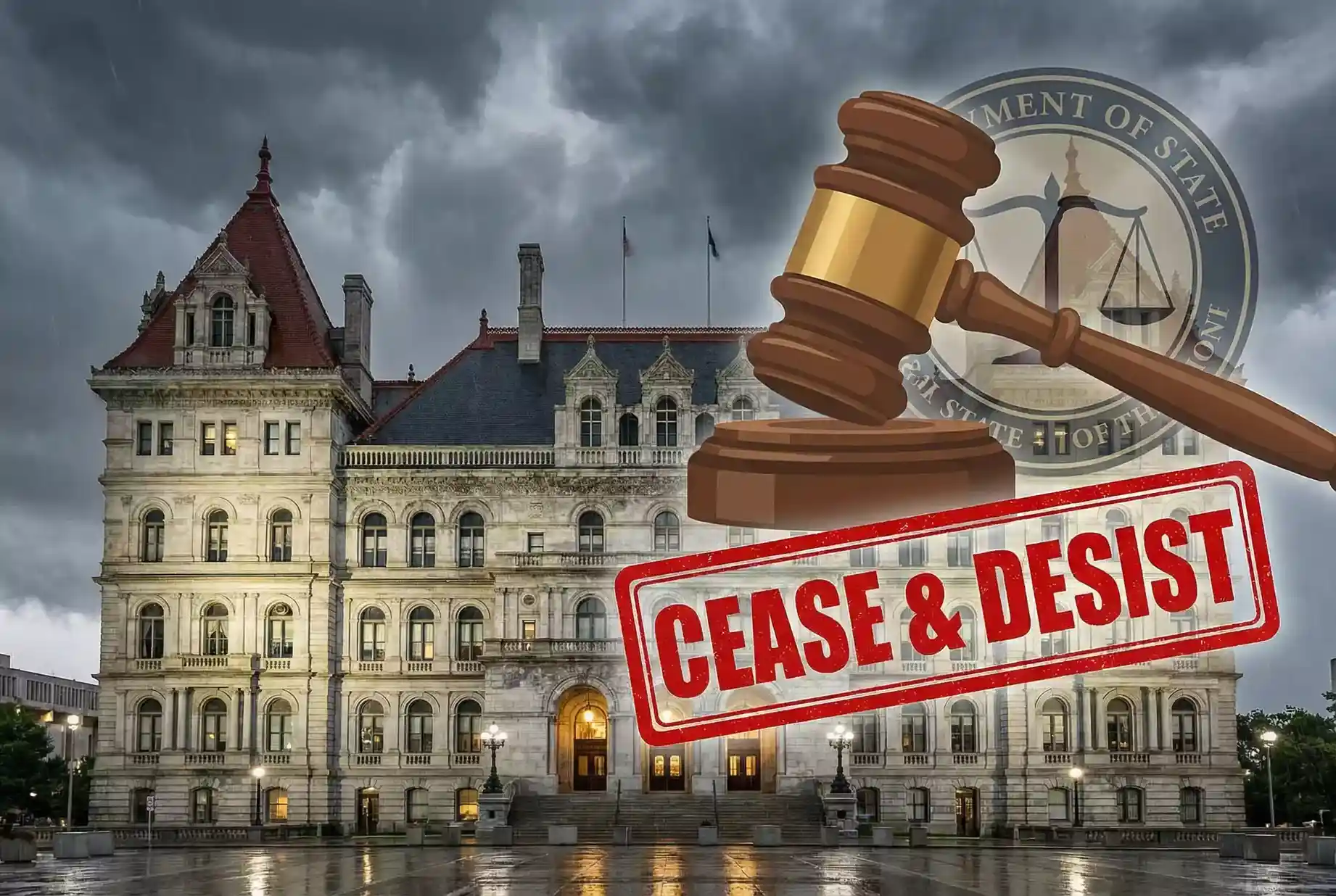
New York’s Attorney General didn’t wait for legislation. In 2025, the office took direct action against sweepstakes casinos, sending cease-and-desist letters to 26 platforms operating in the state. The message was unambiguous: pack up or face consequences.
For New York players, the crackdown transformed the sweepstakes landscape overnight. Platforms that had freely accepted registrations from Empire State addresses suddenly geo-blocked the state entirely. Others continued operating, calculating that cease-and-desist letters carried less weight than actual legislation.
Understanding what happened in New York matters beyond state lines. The AG’s aggressive enforcement approach has drawn attention from regulators nationwide, potentially signaling a new phase in how states address sweepstakes gaming without waiting for legislative action. This analysis examines the crackdown’s mechanics, its impact on players, and what comes next.
Timeline of Enforcement: How New York Moved Against Sweepstakes
Attorney General Letitia James launched the coordinated crackdown in June 2025, issuing cease-and-desist letters to 26 sweepstakes platforms simultaneously. The action came without advance warning to operators, catching many mid-promotional campaign. Within days, the AG’s office issued public statements declaring sweepstakes casinos illegal under existing New York gambling statutes.
The 26 platforms receiving letters represented a cross-section of the industry: major operators with millions of users alongside smaller niche sites. Selection criteria appeared to focus on platforms actively marketing to New York residents or processing significant transaction volume from the state. Some operators not on the initial list received letters in subsequent weeks as enforcement expanded.
The cease-and-desist letters carried explicit demands: stop accepting New York players, stop processing transactions from New York addresses, and stop advertising to New York audiences. Platforms were given limited windows to comply before facing escalation. The AG’s office made clear that continued operation would result in civil enforcement actions and potential referrals for criminal prosecution.
New York’s action didn’t occur in isolation. Nationally, regulators sent more than 100 cease-and-desist letters to sweepstakes operators during 2025, according to iGaming Business reporting. New York’s coordinated, publicized approach represented the most aggressive single-state action, but it fit a broader pattern of regulatory pressure building across jurisdictions.
Platform responses varied dramatically. Some operators immediately geo-blocked New York and issued statements emphasizing compliance with regulatory directives. Others continued serving New York players while challenging the legal basis of the cease-and-desist letters through counsel. A few smaller platforms simply went dark, abandoning US operations entirely rather than fighting state-by-state battles.
The Legal Case Against Sweepstakes in New York
New York’s legal argument rests on a straightforward proposition: sweepstakes casinos function as gambling enterprises regardless of their promotional framing. The AG’s office contends that the dual-currency model—where players purchase Gold Coins and receive Sweeps Coins as promotional bonuses—represents a thinly disguised mechanism for betting real money on games of chance.
Existing New York gambling statutes prohibit unlicensed gambling operations. The AG argues that sweepstakes casinos meet the statutory definition by accepting something of value (money for Gold Coin packages), providing games of chance (slots, table games), and awarding prizes of value (cash redemptions). The sweepstakes label, in this view, doesn’t change the substance of the activity.
The industry’s counter-argument centers on the no-purchase-necessary requirement fundamental to legitimate sweepstakes. Operators maintain that since players can obtain Sweeps Coins through free methods—daily bonuses, mail-in requests, social media giveaways—the platforms operate as promotional sweepstakes rather than gambling. Federal sweepstakes law permits such promotions, and operators argue state gambling statutes don’t apply.
New York’s response: the existence of free entry doesn’t transform gambling into a sweepstakes when the overwhelming majority of participants pay money and the operation functions identically to a casino. The AG’s office points to revenue figures showing that free methods constitute a trivial percentage of total Sweeps Coins acquired, undermining claims that these platforms operate primarily as promotional sweepstakes.
The legal questions remain largely untested in New York courts. Cease-and-desist letters represent enforcement threats rather than judicial rulings. Should operators challenge the AG’s position through litigation, courts would ultimately determine whether sweepstakes casinos fall under existing gambling prohibitions or constitute protected promotional activity.
Which Platforms Stopped Serving New York
Major platforms responded to the AG’s action with varying degrees of compliance. Chumba Casino, the market leader, implemented geo-blocking for New York users shortly after receiving its cease-and-desist letter. The platform’s approach reflected its general strategy of avoiding regulatory confrontation—when states push back, Chumba typically withdraws rather than fights.
Stake.us, already facing regulatory pressure in multiple states, added New York to its restricted territories. The platform’s existing controversies made confrontation with another state attorney general unappealing. Players with existing balances were given windows to request redemption before account access ended.
Smaller platforms showed mixed responses. Some immediately complied, others delayed, and a few continued operating as of early 2026. The platforms still accepting New York players generally maintain lower profiles, operate with less venture capital backing, or calculate that enforcement probability remains low enough to justify the risk.
For players caught in the transition, the experience varied. Those using platforms that communicated clearly received notice, redemption windows, and orderly account closures. Others logged in to find their accounts already restricted, sometimes with balances that required support tickets to resolve. The inconsistency reflected the ad-hoc nature of the crackdown and varying operator preparedness.
Risk assessment for New York players using remaining platforms involves weighing several factors: enforcement probability (still unclear), account security (platforms under regulatory pressure may face operational disruptions), and redemption reliability (stressed operators sometimes delay withdrawals). The calculus differs from using sweepstakes casinos in states without active enforcement.
Legal Gaming Options for New York Residents
New York offers several regulated gaming options that sweepstakes casino users might consider. The state’s commercial casinos—including Resorts World in the Catskills and del Lago in the Finger Lakes—provide full casino experiences with slots, table games, and poker rooms. Physical access requirements limit convenience, but legal status eliminates regulatory uncertainty.
Horse racing and off-track betting operate legally throughout New York, with both physical OTB locations and online advance deposit wagering platforms available. While different from casino gaming, horse racing provides real-money action for residents seeking legal outlets. The state’s racing industry remains substantial, with multiple active tracks.
Daily fantasy sports platforms including DraftKings and FanDuel operate legally in New York following specific regulatory authorization. DFS provides competitive, skill-influenced gaming with real-money outcomes. Players who enjoyed the competition aspect of sweepstakes gaming may find DFS partially satisfies that interest.
Mobile sports betting launched in New York in 2022 and now represents one of the largest legal sports betting markets in the country. Multiple licensed operators accept wagers on professional and college sports. For sweepstakes users whose engagement centered on the thrill of winning rather than specific game formats, sports betting offers a legal alternative.
Pure social casinos—platforms offering Gold Coins or similar play-money currencies without redemption options—remain legal. These apps provide casino-style entertainment without real-prize potential. For players who enjoyed sweepstakes gaming primarily for the gameplay rather than the redemption opportunity, social casinos offer unlimited legal access.
The Future of Sweepstakes Gaming in New York
New York’s sweepstakes casino ban is now law. Governor Kathy Hochul signed Senate Bill 5935 in December 2025, formalizing what AG enforcement had already achieved in practice. The legislation creates penalties of $10,000 to $100,000 per violation and extends liability to payment processors, content suppliers, and affiliate marketers supporting prohibited activity.
The economic impact is substantial. A study cited by the Social Gaming Leadership Alliance estimated sweepstakes casinos generated more than $762 million in New York sales in 2024—representing over 7% of the entire US market. Net revenue from New York players exceeded $250 million. Those figures explain industry opposition but didn’t sway lawmakers who viewed the platforms as unregulated gambling operations.
New York joins California, Montana, Connecticut, and New Jersey among states that enacted sweepstakes bans in 2025. The pattern suggests regulatory momentum rather than isolated actions. For the sweepstakes industry, losing both California and New York—the two largest consumer markets—represents an existential threat to the current business model.
For New York players, the landscape is now clearly defined: sweepstakes casinos are illegal, enforcement mechanisms exist, and legal alternatives must be found elsewhere. The practical advice: use regulated options like sports betting, DFS, or physical casinos, and don’t expect sweepstakes platforms to return without fundamental changes in how the industry operates and how regulators perceive it.
Created by the "Free SC Online Casino" editorial team.